


MOM: Chani Getter
JOB: Licensed Clinical Social Worker and interfaith minister
LOCATION: Hackensack, New Jersey
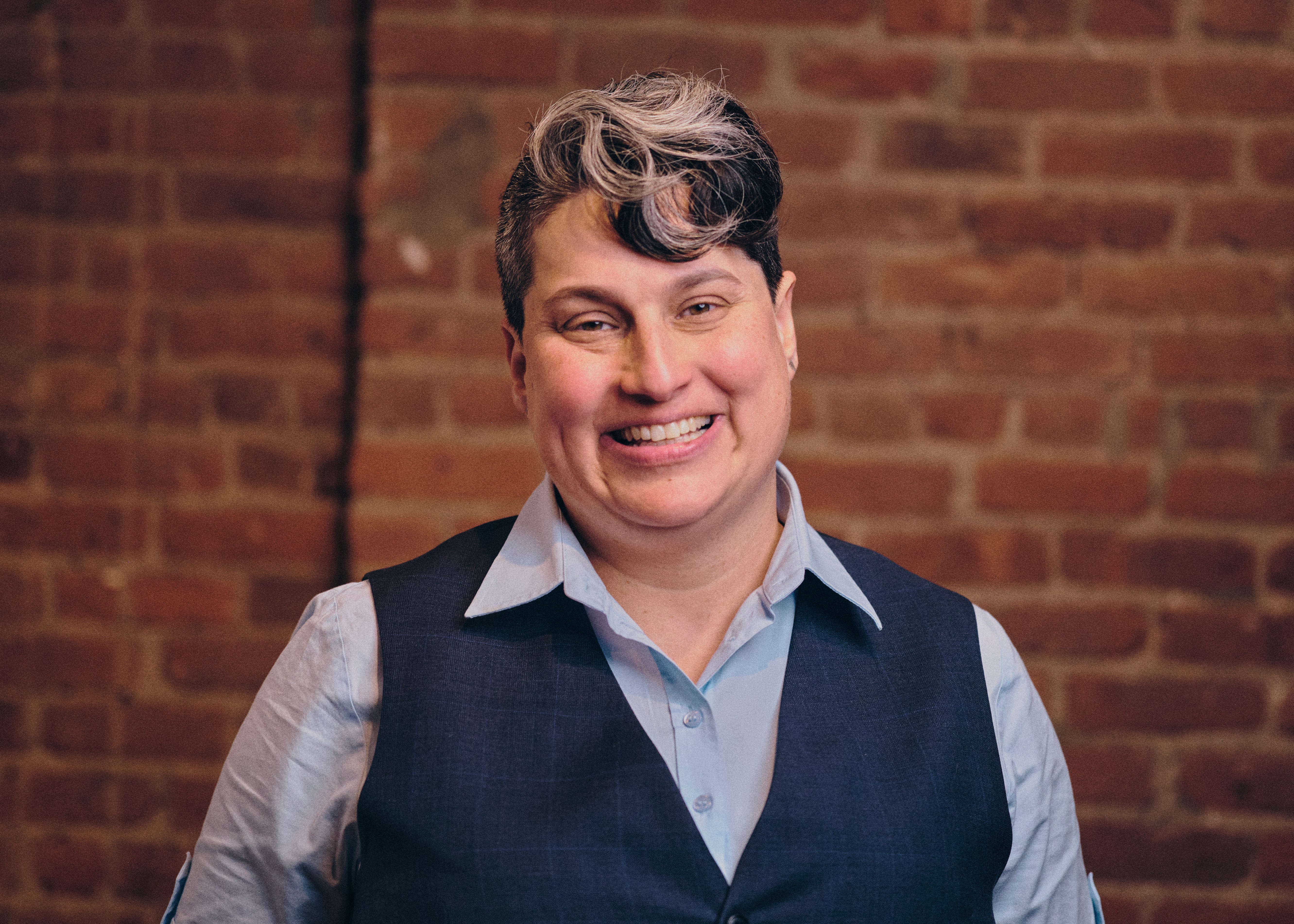
“I tell my kids, ‘I never wanted to be a mom, and you were the best thing that ever happened to me.’ Both of those things can be true.”
Babies and children are everywhere in ultra-Orthodox Jewish communities. I see them in their matching outfits whenever I drive through certain neighborhoods in Brooklyn. Their mothers never far behind. And while I haven’t encountered a lot of literature about this particular experience of motherhood, I imagine it comes with certain expectations.
One study concluded that “Haredi women are acculturated to the routines of pregnancy, childbirth, and a habitual position of receptiveness toward continuous childbearing as an act of religious devotion.”
That assessment resonates with Chani Getter, who entered an arranged marriage at 18 and had three children before leaving ultra-Orthodoxy at the age of 23. “I never wanted to be a mother,” they tell me. “There was this expectation that because you’re female, you’re going to have children and naturally know how to take care of them. The people around you will help you, but ultimately it’s your responsibility.”
But raising kids is precisely what propelled Chani to change the course of their life: “The reason I left wasn’t because I’m queer, even though I happen to be gay, but because I needed to keep my children safe. That overprotective maternal instinct made me do it. And looking back, I still don’t understand how I had the guts,” they say. “I was stupid and desperate, but also resilient and young.”
The Mommune Q&A:
What happened when you left the Hasidic community?
Chani: I didn’t know where I was going. I just kept stepping out slowly with the help of an incredible therapist who let me take those small steps. I also kept building community along the way. Much of my village was queer and Jewish. When I was coming out, about 25 years ago, Jewish filmmaker Sandi Dubowski made Trembling Before God, a movie about gay people in the Orthodox world. I went to a screening, and he noticed me because I was dressed religiously. He ended up inviting me to a weekend event where I met people still in my family’s life.
Your kids are in their late 20’s and early 30’s now. Do they know you never wanted to be a mom?
Chani: I tell them “I never wanted to be a mom, and you were the best thing that ever happened to me.” Both of those things can be true. I grew up with them, and I grew up because of them. I wouldn’t be who I am if I hadn’t been a mother.
What helped you show up as your best self while getting by as a single parent?
Chani: I would go to the mirror and say, “How do I want to be remembered by my children?” When I asked myself that question, I was more loving. I was kinder. I was gentler. My heart was bigger. My energy was softer. If the house was a mess, I was ok with that because I showed up in the way that I wanted my kids to remember. As a single parent, I knew that if I were to die, my children would be given to my family, even though they didn’t have a relationship with any of them. That’s how the courts work. But none of these people would correctly remember me for my children. So, I needed to build those memories.
“As someone deeply wounded, my mother could not understand or hold any of her five children in the way we needed or wanted.”
How do you see your role as a parent?
Chani: There’s a poem by Kahlil Gibran that captures it: “Your children are not your children. / They are the sons and daughters of Life’s longing for itself. / They come through you but not from you, / And though they are with you yet they belong not to you.” My ceiling is my children’s floor, and the way to make that ceiling higher is by taking care of myself and growing into the best parts of me.
What kind of mother raised you?
Chani: Someone who had a lot of trauma. My mother was born right after World War II in a displaced persons camp in Germany. Her parents were Holocaust survivors who met and started a family in the camps because they had nowhere else to go. My mother is an incredible untrained artist who can play any instrument by ear. Yet, she spent her life working in an office to support us. She’s also an extremely spiritual human who talks to God as if God is her friend. But as someone deeply wounded, she could not understand or hold any of her five children in the way we needed or wanted.
Your family disowned you before you left the community. How did it feel to lose your mother in that way?
Chani: It was painful but expected. After seven years of not speaking to me, [my parents] invited me back into the house, and it was strained. So, it’s complicated. I have tremendous compassion for my mom’s journey, and I know that she probably did the best she could with all of us. But I don’t expect anything from her.
Do your children have a relationship with your mom?
Chani: Not with my parents, but they have a beautiful relationship with their father’s mother. My kids are so different from her other grandkids because they’re outside of the community. And she loves and accepts them for who they are. That’s such a gift.
What place does religion have in your life today?
Chani: It plays a huge role. I lead services in liberal Jewish spaces. I am an interfaith minister, and so I create weddings, funerals, baby blessings, and everything in between for people in interfaith relationships. To me, the universe is bigger than one God.
How do you define self-care?
Chani: I start almost every day with a walk that takes somewhere between 30 to 60 minutes. Sometimes I just pray in the woods. But self-care is about space, time, and reflection. We live in a society that presses us to fill up every hour of the day, but my most creative moments happen when there isn’t that structure.
What does mothering look like now?
Chani: I don’t think you ever stop mothering. Even though my kids have friends and beautiful communities and are doing great, sometimes they need their mom. And so I know when to show up.
Thanks to Chani for sharing their story. Chani also serves as scholar-in-residence at Footsteps, an organization offering unconditional support to anyone transitioning out of ultra-Orthodox communities.